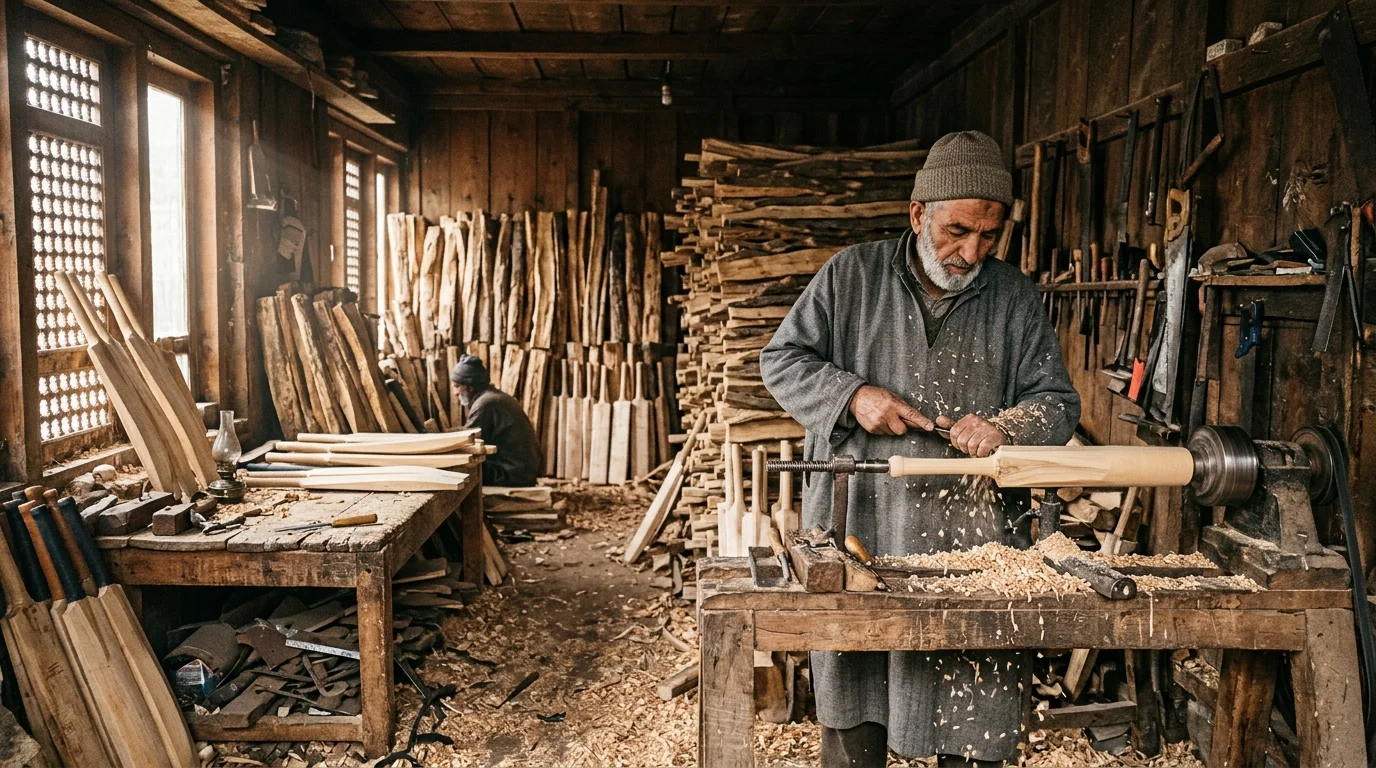
Along the 30-kilometer stretch of the Srinagar-Jammu National Highway (NH-44), specifically between Sangam, Bijbehara, and Halmulla in Anantnag district, thousands of freshly shaved wooden bats line the roadsides in pyramid stacks. This is the global ground zero of Kashmir Willow (Salix alba var. caerulea)—the only timber on earth, beside English Willow, certified by the International Cricket Council (ICC) for professional international play.
While top international batters have used Kashmir Willow bats in ICC World Cup tournaments to score 100-meter sixes, visiting cricket enthusiasts face a chaotic marketplace. Highway retail showrooms routinely pass off unseasoned wood, paint over heavy knots, slap counterfeit English Willow brand stickers on sub-standard clefts, or overcharge amateur players by 300%.
As locals who pass through the Sangam bat belt regularly, this guide provides the unvarnished, technical playbook for buying a genuine, hard-hitting Kashmir Willow bat directly from the source.
1. Kashmir Willow vs. English Willow: The Honest Comparison
Before visiting the factories, you must understand the genuine structural differences between the two woods:
| Factor | Kashmir Willow (*Salix alba*) | English Willow (*Salix alba var. caerulea*) | Practical Meaning for Cricketers |
|---|---|---|---|
| Timber Color & Tint | Naturally reddish-brown / darker honey hue. | Creamy white / pale ivory tone. | Kashmir willow has natural mineral streaks; pure white appearance indicates artificial bleach. |
| Fiber Density & Weight | Higher density, tighter cell walls (slightly heavier by 50–80g). | Lighter, softer cell structure. | Kashmir willow offers unmatched durability against hard seam leather balls; English willow has a marginally softer rebound. |
| Durability & Longevity | Extremely High (2–4 seasons under heavy use). | Moderate (prone to toe cracks and edge feathering). | Kashmir willow is much more forgiving on hard, gritty Asian club wickets and heavy tennis-ball play. |
| Price Range | ₹1,000 – ₹6,500 for Grade 1 Master Clefts. | ₹12,000 – ₹70,000+ for equivalent grade. | Kashmir willow provides 85–90% of English willow punch at 10% to 15% of the financial cost. |
2. Where to Buy: The Sangam Bat Manufacturing Cluster
Over 400 registered cricket bat factories operate along the Jhelum river basin. Do not buy cricket bats from tourist souvenir shops on Boulevard Road or Dal Lake in Srinagar. Those shops add a 100% middleman markup and stock mass-produced clearance bats.
Instead, visit the source directly when driving between Srinagar and Pahalgam:
[Srinagar] ──(35 km South on NH-44)──> [Sangam & Halmulla Bat Belt] ──(45 km East)──> [Pahalgam]
- The Epicenter: The villages of Sangam, Halmulla, and Pujteng in Anantnag district.
- How to Visit: Stop your vehicle on NH-44. Most factories have road-facing retail showrooms attached directly to their seasoning sheds and lathe turning workshops.
- Factory Access: Reputable manufacturers will willingly let you walk into the back shed to select unbranded, raw clefts (un-pressed wood) before handles, grips, and stickers are applied.
3. How to Grade and Inspect a Kashmir Willow Bat: The 5-Step Test
Never select a bat based on the brand sticker or colored rubber grip. Use this step-by-step checklist used by professional bat makers:
Step 1: Count and Trace the Grains
- Look at the face of the raw blade. Grains are the vertical growth lines running from the handle down to the toe.
- Grade 1+ / Player Grade: 6 to 10 straight, equidistant vertical grains with minimal heartwood blemishes.
- Grade 2 / Club Grade: 4 to 6 straight grains; minor cosmetic variations allowed.
- Grade 3 / Casual Grade: 3 to 4 irregular or angled grains.
- Local Rule: Straight, tight grains indicate a mature tree with uniform density and predictable rebound.
Step 2: The Mallet Tap Rebound Test (The "Ping")
- Ask the factory craftsman for a standard wooden ball mallet or an old leather cricket ball.
- Lightly bounce the ball up and down from the toe, through the mid-blade (sweet spot), up to the splice.
- What to listen for: The sweet spot (usually 4 to 8 inches above the toe) should produce a crisp, high-pitched "ping" with zero hollow vibration in your hands. If the wood sounds dull, damp, or dead, the cleft was not properly kiln-seasoned and still retains green moisture.
Step 3: Check Balance and Pickup Weight
- Static scale weight is secondary to pickup balance.
- A bat weighing 1,180 grams with excellent weight distribution toward the spine will feel lighter in the hands than a poorly balanced 1,120-gram bat.
- Hold the handle with your standard batting grip, execute a backlift and follow-through shadow stroke. The toe should not drag downwards.
Step 4: Inspect the Handle & Cane Construction
- The handle must be constructed from multi-piece imported Singapore Cane (usually 3 to 4 rubber/cork laminations visible at the top).
- Avoid cheap pine-wood or single-piece timber handles; they snap under the impact of a 130 km/h delivery and transfer severe stinging vibrations to the batter's wrists.
Step 5: Verify Edge and Toe Thickness
- Modern aggressive bats feature 38mm to 42mm edges and a curved bow with a 60mm+ spine.
- Ensure the toe is not shaved too thin (minimum 15mm–18mm thickness), as thin toes easily crack on yorkers.
4. Honest Price Matrix for Kashmir Willow Bats (2025/2026)
Here is what you should realistically pay directly at Sangam factory workshops:
| Bat Category / Grade | Fair Factory Price (Sangam) | Boulevard / City Tourist Markup | Recommended Ball Type |
|---|---|---|---|
| Hard Tennis / Light Tennis Ball Bat | ₹600 – ₹1,200 | ₹1,800 – ₹2,500 | Scooped spine, ultra-lightweight; ideal for tennis ball street cricket. |
| Club Grade Leather Ball (Grade 3) | ₹1,400 – ₹2,200 | ₹3,000 – ₹4,200 | 4–5 grains; perfect for weekend league practice and net bowling. |
| Semi-Pro Leather Ball (Grade 2) | ₹2,500 – ₹3,800 | ₹5,000 – ₹7,000 | 5–7 straight grains; excellent rebound, pressed Singapore cane handle. |
| Master / Pro Grade 1+ (Player Edition) | ₹4,500 – ₹6,800 | ₹8,500 – ₹14,000 | 7–10 straight grains, seasoned cleft, monster 40mm edges, supreme ping. |
| Junior / Kids Sizes (Sizes 1 to 5) | ₹400 – ₹900 | ₹1,200 – ₹1,800 | Scaled down clefts for school beginners and young players. |
5. Critical Post-Purchase Care: Knocking-In & Oiling
A brand-new Kashmir Willow bat cannot be taken directly from the factory into a match with a hard leather ball. Doing so will crack the face or break the edges.
- Raw Linseed Oil Treatment: Apply 1 teaspoon of raw linseed oil across the face, edges, and toe using a soft cloth (avoid the splice and handle). Let the bat rest horizontally for 24 hours to let the oil penetrate the dry willow fibers.
- Knocking-In (Mandatory):
- Many Sangam factories offer machine knocking on-site for ₹150–₹250 using automated pneumatic rollers.
- If knocking manually, spend 4 to 6 hours gently tapping the face and rounded edges with a wooden mallet, gradually increasing impact until the surface shows no indentations from a leather seam.
- Toe Guard & Scuff Sheet: Apply an anti-scuff protective clear sheet on the face and a rubber toe guard to prevent moisture absorption from damp early-morning grass.
Frequently Asked Questions (Kashmir Willow Cricket Bats)
Can I carry a cricket bat in flight from Srinagar Airport?
Yes, but cricket bats are strictly prohibited in cabin carry-on luggage under Bureau of Civil Aviation Security (BCAS) regulations. You must pack the bat securely inside your checked luggage or have the factory bubble-wrap and box it for drop-off as separate checked baggage. Most airlines allow 1 boxed bat as part of your standard checked allowance.
How can I spot a counterfeit English Willow sticker on a Kashmir bat?
Scam vendors often paste premium English labels ("Grade 1 English Willow") on cheap wood. Check the natural wood grain color: English willow is pale cream-white; Kashmir willow has a richer honey-amber hue with darker fibrous lines. If the price is under ₹8,000 and the vendor claims it is "English Willow", it is 100% counterfeit.
Are tennis-ball bats different from leather-ball bats?
Yes. Tennis-ball bats are designed with deep aerodynamic "scoops" carved out of the back spine to reduce weight to 950–1,050 grams for fast wrist speed. Never use a scooped tennis-ball bat against a leather cricket ball—the thin face will shatter on impact.
Explore Authentic Kashmiri Craftsmanship with Local Guides
Plan your artisan and shopping visits with our comprehensive insider guides:
- 🧣 Identify genuine Pashmina with the Kashmir Pashmina Buying Guide
- 🌸 Buy genuine saffron at farm rates with the Kashmir Saffron Buying Guide
- 🪵 Master wood carving secrets with the Kashmir Walnut Wood Carving Guide
- 🚕 Review highway cab fares on the Kashmir Taxi Union Rates
- 📩 Need custom ground advice? Reach our local desk via Contact Travel Desk.

Born and raised in Srinagar with 8+ years traversing high-altitude passes, Mughal heritage circuits, and remote Himalayan corridors. Leads core trip planning, logistics architecture, and seasonal budget audits.
🛡️ Ground-Verified Fact Checking • Srinagar Travel Desk
Plan Your Kashmir Journey with Local Confidence.
Have questions about official taxi union rates, Gondola booking windows, or current seasonal weather? Tell us your dates. Our Srinagar desk verifies your plan and gives you honest local advice in 4 hours.