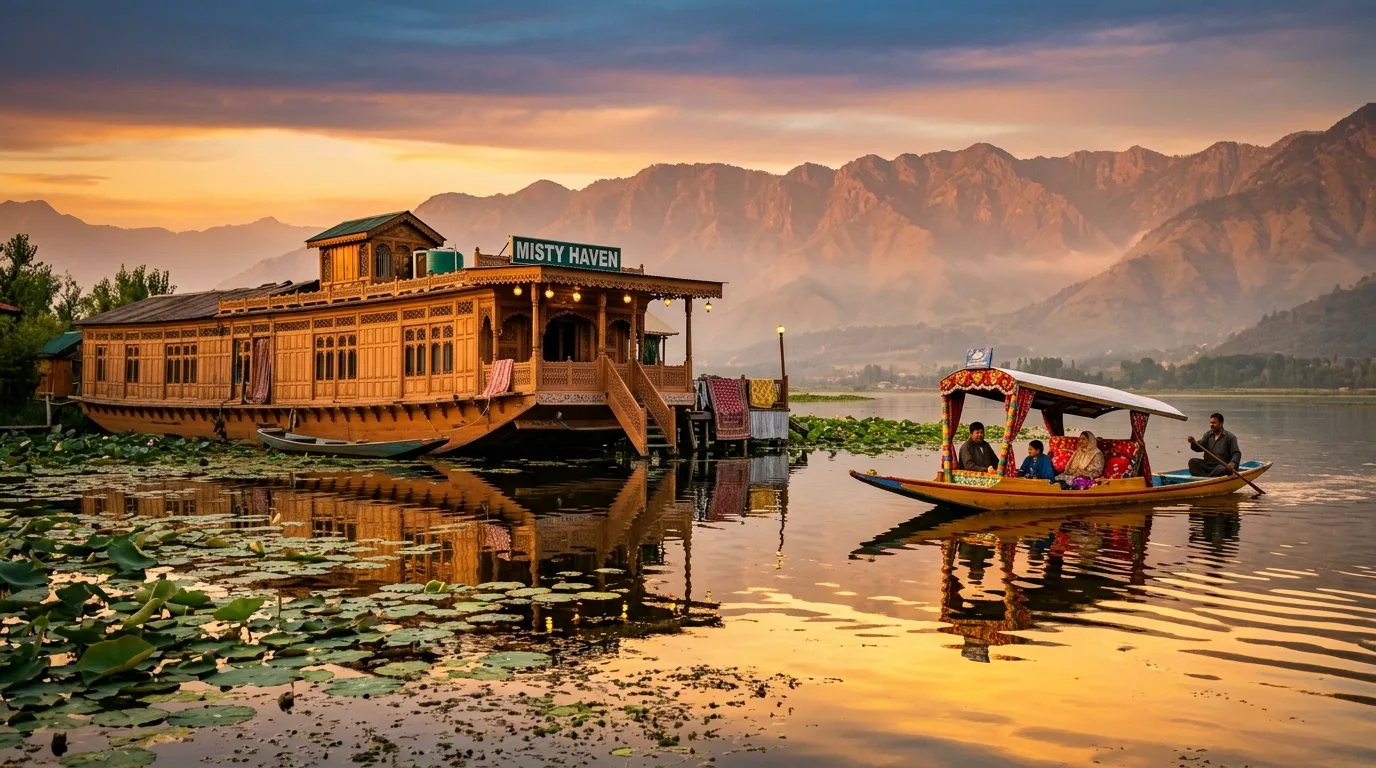
Srinagar (elevation 1,585 m / 5,200 ft) is the summer capital of Jammu & Kashmir and the historic heart of the Kashmir Valley. Spanning both banks of the Jhelum River and framed by the serene waters of Dal Lake, Nigeen Lake, and the towering Zabarwan mountain range, Srinagar is a city where 17th-century Mughal gardens, 14th-century wooden Islamic architecture, cedar-carved houseboats, and a 36-course culinary tradition (Wazwan) converge into one of Asia's most captivating Himalayan destinations.
1. Geography & District Overview
Situated in the center of the Kashmir Valley, Srinagar is located 295 km north of Jammu and serves as the primary gateway for all travel across Jammu & Kashmir, including onward circuits to Gulmarg (52 km west), Pahalgam (90 km south), Sonamarg (80 km northeast), and Gurez Valley (123 km north). The city is geographically defined by three major water bodies:
- Dal Lake: Covering 18 square kilometers, Dal Lake is the focal point of Srinagar's tourism, famous for houseboats, floating vegetable markets, and Shikara channels.
- Nigeen Lake: A quieter, deeper lake located to the northwest of Dal Lake, separated by a narrow causeway. Ringed by weeping willows and poplar trees, Nigeen is favored by travelers seeking tranquility.
- Jhelum River (Veth): The historic lifeline of Old Srinagar, winding through seven ancient wooden bridges (Kadals) that connect historic neighborhoods.
2. The Complete Srinagar Houseboat Master Guide
Staying on a floating houseboat is Srinagar's signature accommodation experience. Houseboats originated during the late 19th-century British colonial era when the Maharaja of Jammu & Kashmir prohibited British officers from purchasing land in the valley. In response, clever Kashmiri merchants constructed luxurious floating wooden palaces anchored along the lakes.
Dal Lake vs. Nigeen Lake Houseboats
- Dal Lake (Boulevard Road / Ghats 1–24): Dal Lake houseboats are vibrant, central, and lined along Boulevard Road. Staying here places you within walking distance of local restaurants, craft shops, and central taxi stands. However, front-row houseboats near main ghats can experience boat traffic and noise during peak summer season.
- Nigeen Lake Houseboats: Located 6 km from city center, Nigeen Lake houseboats are nestled in peaceful, crystal-clear water with minimal motorboat traffic. Ideal for honeymooners, artists, and readers.
Houseboat Construction & Winter Heating
Authentic Kashmiri houseboats are hand-crafted from fragrant, water-resistant Deodar (Cedar) wood. Interiors feature intricate hand-carved ceilings (Khatamband—interlocking wooden geometric tiles), heavy Persian wool carpets, cut-glass chandeliers, and hand-carved walnut furniture. Modern houseboats feature private attached bathrooms with hot water geysers. During freezing winter months (December to February), houseboats are heated using electric blankets, central heating radiators, or traditional charcoal stoves (Bukhari).
Official J&K Tourism Houseboat Categories & Pricing
- Deluxe / Luxury Category: ₹4,500 – ₹9,000 per room per night (Includes breakfast, dinner, and dedicated houseboat butler).
- A-Grade Category: ₹3,000 – ₹4,500 per room per night.
- B-Grade / Budget Category: ₹1,800 – ₹2,800 per room per night.
3. Official Shikara Union Rates, Ghats & Circuit Routing
A Shikara is a traditional wooden canoe fitted with a colorful canopy, padded cushions, and a flat prow. Shikara operators are governed by the J&K Tourism Department and the Shikara Workers Union.
Official Government Rates & Etiquette
The official government-approved rate for a Shikara is ₹800 per hour per boat (carrying up to 4 adult passengers). Always confirm the duration and route with your boatman at the Ghat before embarking.
Popular Shikara Routes & Circuits
- 1-Hour Sunset Circuit: Departs from Boulevard Ghats (Ghat 1 to 7) to Char Chinar island (a small island in the middle of Dal Lake named after four majestic Chinar trees) and returns as the sun dips behind the Zabarwan mountains.
- 2-Hour Interior Lake Tour: Covers Char Chinar, Nehru Park, floating lotus gardens, Meena Bazaar (floating shops selling shawls, saffron, and jewelry), and wooden residential hamlets inside the lake.
- Dawn Floating Vegetable Market Tour (5:00 AM – 7:00 AM): A unique 2-hour early morning excursion to the center of Dal Lake. Here, local Kashmiri aquatic farmers gather on Shikaras to barter and trade fresh vegetables (lotus roots, collard greens, cucumbers) grown in floating water gardens (Radh). This is a pure, uncommercialized local tradition and a dream for photographers.
4. The Royal Mughal Gardens Circuit
Inspired by the Persian Charbagh (four-square garden concept symbolizing Paradise), Srinagar's Mughal Gardens were constructed during the golden age of the Mughal Empire in the 17th century. Terraced lawns, stone water chutes (chahars), fountain pools, and massive centuries-old Chinar trees define these garden layouts:
Nishat Bagh (Garden of Pleasure)
Built in 1633 AD by Asif Khan, the elder brother of Empress Nur Jahan, Nishat Bagh is the second-largest Mughal garden in the valley. It features 12 terraced levels representing the 12 signs of the zodiac, rising steeply up the Zabarwan hills. The top terrace offers a panoramic view over the full expanse of Dal Lake. Entry ticket: ₹25.
Shalimar Bagh (Abode of Love)
Built in 1619 AD by Mughal Emperor Jahangir for his beloved wife Nur Jahan, Shalimar Bagh is considered the high point of Mughal horticulture. The garden is divided into three sections: the outer garden (Diwan-i-Aam), the middle garden (Diwan-i-Khas), and the private royal zenana garden featuring a polished black marble pavilion surrounded by cascading waterfalls. Entry ticket: ₹25.
Cheshma Shahi (The Royal Spring)
Built in 1632 AD by Governor Ali Mardan Khan under Emperor Shah Jahan, Cheshma Shahi is the smallest and most charming Mughal garden. It is constructed around a natural mountain spring whose cold, mineral-rich water is renowned for its digestive properties. Entry ticket: ₹25.
Pari Mahal (Palace of Fairies)
Located high above Cheshma Shahi on the Zabarwan mountain ridge, Pari Mahal was built by Prince Dara Shikoh (eldest son of Shah Jahan) in the mid-17th century as an observatory for astrology and Islamic learning. The seven-terraced stone structure offers the finest bird's-eye view of Srinagar city, Dal Lake, and the Royal Springs Golf Course. Entry ticket: ₹25.
Indira Gandhi Memorial Tulip Garden (Spring Special)
Spread over 30 hectares at the base of the Zabarwan range, this is Asia's largest tulip garden. Open exclusively for 3 to 4 weeks between late March and mid-April, the garden displays over 1.5 million tulip bulbs across 65 vibrant varieties, alongside daffodils, hyacinths, and ranunculus. Entry ticket: ₹75.
5. Old City (Shehr-e-Khas) Heritage Walk
To experience the authentic soul of Srinagar away from tourist hubs, walk through the historic medieval neighborhood of Shehr-e-Khas (Old City) along the Jhelum River:
Jamia Masjid (Nowhatta)
Constructed in 1394 AD by Sultan Sikandar and expanded by his son Sultan Zain-ul-Abidin (Budshah), Jamia Masjid is an architectural masterpiece of Indo-Saracenic design. Unlike traditional vaulted domes, the mosque features a central square courtyard surrounded by covered wooden cloisters supported by 378 massive, uncarved Deodar tree trunk pillars, some standing over 50 feet high.
Khanqah-e-Moula (Zaina Kadal)
Situated on the right bank of the Jhelum River, Khanqah-e-Moula was built in 1395 AD to commemorate Mir Sayyid Ali Hamadani (R.A.), the Persian Sufi scholar who introduced Islam and traditional Persian crafts (carpet weaving, papier-mâché, shawl weaving) to Kashmir. The wooden shrine is renowned for its vibrant green and gold papier-mâché wall paneling, carved timber spires, and intricate wood lattice windows.
The 7 Historic Bridges (Kadals) of Jhelum
Historically, Old Srinagar was connected across the Jhelum River by seven wooden cantilever bridges built between the 15th and 18th centuries: Amira Kadal, Habba Kadal, Fateh Kadal, Zaina Kadal, Ali Kadal, Nawa Kadal, and Safa Kadal. Walking along these bridges offers glimpses of traditional wooden house architecture (Dhajji-Dewari timber-laced masonry designed to withstand earthquakes).
6. The Complete Srinagar Food & Dining Map
Srinagar is a paradise for meat lovers, tea connoisseurs, and bakery enthusiasts:
The 36-Course Wazwan Feast
Wazwan is the ultimate Kashmiri royal banquet. Mutton is hand-pounded on wooden blocks by master chefs (Vasta Wazas) and slow-cooked over copper pots. Served on a copper platter (Traem) for four people, key dishes include Rista (saffron mutton balls), Rogan Josh (fragrant lamb shanks), Tabak Maaz (crispy fried lamb ribs), and Gushtaba (velvety yogurt mutton meatballs).
- Ahdoos Restaurant (Residency Road): Established in 1918, Ahdoos is Srinagar's iconic establishment for authentic Wazwan.
- Mughal Darbar (Residency Road): Famous for Wazwan mini-platters and traditional seating.
- Kareema Restaurant (Residency Road): Excellent budget-friendly local Wazwan plates.
Winter Breakfast Harissa
Available between November and March, Harissa is a slow-cooked paste of boneless mutton, rice, garlic, and spices stirred in underground pots for 12 hours. Served at dawn (6:00 AM to 8:30 AM) in Old City bakeries (Aali Kadal, Saraf Kadal) topped with sizzling ghee and hot Girda bread.
Evening Tujji Kebabs at Khayam Chowk
Every evening, Khayam Chowk transforms into an open-air barbecue street. Chunks of marinated mutton or chicken are grilled on long iron skewers over charcoal embers and served on thin Lavas bread with 5 varieties of chutneys (walnut-radish, mint, red chilli).
7. Authentic Shopping & GI-Purity Verification Guide
- GI-Tagged Kashmiri Pashmina: Authentic hand-spun, hand-woven Pashmina is made from the undercoat of Changthangi goats. Check for the official government GI (Geographical Indication) registry label and QR code. Real Pashmina passes smoothly through a finger ring and leaves fine ash when a single strand is burned (unlike synthetic fibers which melt into hard beads).
- Kashmiri Saffron (Zafran): Pure Kashmiri saffron stems from Pampore. Mongra saffron consists of deep crimson thread tips. Test purity by dropping 2 strands in warm water—pure saffron slowly releases a golden-yellow hue over 10 minutes while retaining its dark red thread color. Fake saffron bleeds red dye instantly and dissolves.
- Walnut Wood & Papier-Mâché: Visit government-certified shops at Polo View Market or the Kashmir Arts Emporium on Residency Road.
8. Local Transport, Airport Rules & Practical Tips
- Srinagar Airport Security (SXR): Sheikh ul-Alam International Airport has stringent multi-tier security checks. Baggage screening occurs prior to airport gate entry. Arrive at least 3 hours before your scheduled flight departure time.
- Mobile SIM Regulations: Prepaid SIM cards issued outside Jammu & Kashmir do NOT work in J&K due to national security rules. You MUST use a Postpaid SIM card (Airtel, Jio, or BSNL) or purchase a tourist SIM at Srinagar airport upon arrival by presenting your Aadhaar card / Passport.
- Airport to City Taxi Fare: Fixed government prepaid taxi fare is ₹900 – ₹1,200 to Boulevard Road / Dal Lake (14 km, 30 minutes).
- Full-Day City Sightseeing Taxi: ₹2,200 – ₹3,200 per day for Sedan/SUV.
9. Frequently Asked Questions (PAA SERP Analysis)
Q1: Is Srinagar safe for solo travelers and families?
A: Yes, Srinagar is safe for families, couples, and solo travelers. Tourism is the economic backbone of the Kashmir Valley, and local Kashmiris are renowned for their hospitality. Standard travel precautions apply: stay on main tourist corridors (Boulevard Road, Old City, Rajbagh), avoid late-night unlit alleys, and keep your government ID with you.
Q2: Do prepaid SIM cards work in Srinagar?
A: No. Prepaid SIM cards issued outside Jammu & Kashmir do NOT work in Srinagar due to national security regulations. You must convert your existing number to a Postpaid SIM before arrival or purchase a local prepaid tourist SIM card at Srinagar International Airport (SXR) upon landing by showing your Aadhaar card or Passport.
Q3: What is the official rate for a Shikara ride on Dal Lake?
A: The official J&K Tourism approved rate for a Shikara ride is ₹800 per hour per boat (accommodating up to 4 adults). Always verify the price with the boatman at Ghat 1-24 before boarding. For detailed regional planning, see our Kashmir Trip Planning Guide and 5-Day Kashmir Itinerary.
Q4: What is the difference between staying on Dal Lake vs Nigeen Lake?
A: Dal Lake houseboats along Boulevard Road are central, lively, and close to craft markets and restaurants. Nigeen Lake (6 km north) is surrounded by weeping willows and is far quieter with less motorboat noise—ideal for couples and travelers seeking tranquility.
Q5: Where can I eat authentic Kashmiri Wazwan in Srinagar?
A: The top places for authentic Wazwan on Residency Road are Ahdoos Restaurant (established 1918), Mughal Darbar, and Kareema Restaurant. For a detailed food tour, check out our comprehensive Kashmir Food & Wazwan Guide.

Culinary researcher documenting authentic Kashmiri gastronomic heritage—from the ceremonial 36-course Wazwan to traditional winter Harissa and historic Old City bakeries.
🛡️ Ground-Verified Fact Checking • Srinagar Travel Desk
Plan Your Kashmir Journey with Local Confidence.
Have questions about official taxi union rates, Gondola booking windows, or current seasonal weather? Tell us your dates. Our Srinagar desk verifies your plan and gives you honest local advice in 4 hours.