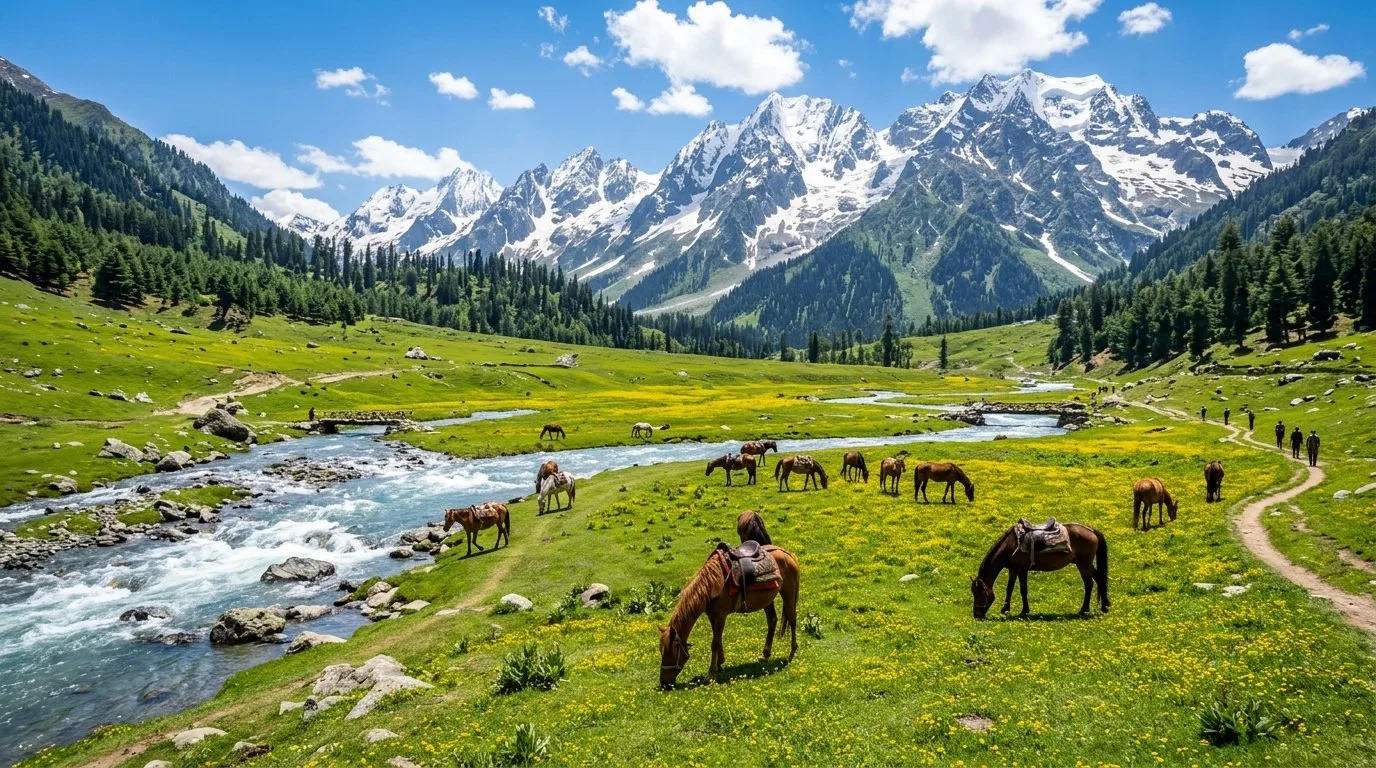
The quintessential Kashmir journey blends serene aquatic heritage, dramatic high-Himalayan altitude ascents, 600-year-old medieval wooden Islamic architecture, and a 36-course royal culinary art form. Far beyond generic travel brochure itineraries, experiencing the authentic soul of the Kashmir Valley requires knowing precisely when and where to go: witnessing the mystical 5:00 AM floating vegetable barter market in the reed channels of Dal Lake, ascending to 3,980 meters on Mount Apharwat aboard the Gulmarg Gondola, walking beneath centuries-old golden Chinars in Naseem Bagh, and sampling steaming winter Harissa in the medieval alleys of Old Srinagar. Below is the definitive, ground-verified guide to the 18 absolute best experiences in Kashmir, authored and fact-checked by Srinagar residents.
1. Quick Reference: Top Kashmir Experiences by Category
| Experience Category | Flagship Activity | Primary Location | Best Season | Approx. Cost |
|---|---|---|---|---|
| High Alpine & Snow | Gulmarg Gondola to Apharwat Peak (3,980 m) | Gulmarg | Dec to May (Snow) · Jun to Sep (Meadows) | ₹1,860 (Phase 1 + 2) |
| Aquatic Heritage | Dawn Floating Vegetable Market & Houseboat Stay | Dal Lake / Nigeen Lake | April to November | ₹800/hr Shikara · Stays from ₹3,500 |
| River & Adventure | White Water Rafting & Trout Angling | Lidder River, Pahalgam | April to September | ₹600 – ₹1,200 per person |
| Heritage & Culture | Old City Shehr-e-Khaas Heritage Walk | Downtown Srinagar | All Year | Free (Guided walks ₹800) |
| Gastronomy | Authentic Royal Wazwan Traem & Winter Harissa | Ahdoos / Aali Kadal | All Year (Harissa: Nov–Mar) | ₹650 – ₹1,000 per person |
| Botanical Marvels | Tulip Festival & Mughal Terraces | Zabarwan Foothills, Srinagar | Tulips: April · Gardens: May–Oct | ₹24 – ₹50 entry tickets |
| Remote Frontier | Expedition to Gurez Valley & Habba Khatoon | Bandipora & Gurez | Late May to October | Cab charter ₹5,500 – ₹6,500 |
2. High Alpine & Mountain Thrills
1. Ride the Gulmarg Gondola to Apharwat Peak (3,980 m)
Ascending into the rarefied air of Mount Apharwat aboard the world's second-highest cable car is Kashmir's single most popular mountain experience. Phase 1 lifts you from the Gulmarg resort bowl (2,650 m) through dense pine canopies to the alpine basin of Kongdoori (3,063 m). Phase 2 climbs dramatically up sheer granite faces to 3,980 meters (13,057 ft), depositing you onto deep powder snow with sweeping vistas extending to Nanga Parbat (8,126 m) and the Line of Control. Tickets must be booked 30 days in advance at jammukashmircablecar.com.
2. Ski and Snowboard Gulmarg's Legendary Powder Snow
Between mid-December and late March, winter storm systems from Central Asia blanket the Pir Panjal range in exceptionally light, dry "curry powder" snow. Beginners can hire equipment (₹800/day) and certified instructors (₹1,500/day) on gentle nursery slopes near the Indian Institute of Skiing and Mountaineering (IISM). Advanced freeriders flock from around the world to drop into the un-groomed, backcountry bowls of Apharwat, riding 2,000 vertical meters of virgin powder through pine glades.
3. Hike to Thajiwas Glacier in Sonamarg
In Sonamarg (the Meadow of Gold), a scenic 45-minute mountain trail leads from the main road along rushing meltwater streams to the foot of Thajiwas Glacier (elevation 3,000 m). Towering jagged peaks, hanging ice falls, and herds of grazing Gujjar ponies frame the landscape. While horse handlers quote up to ₹2,500, the 3 km trail is an easy, highly scenic walk on foot.
4. Witness the Frozen Waterfall at Drung
Tucked in a narrow gorge 16 km below Gulmarg near Tangmarg, Drung Waterfall cascades over jagged cliffs fed by mountain torrents. During deep winter (January to mid-February), when ambient temperatures plunge to -10°C, the rushing falls freeze completely solid into gigantic, translucent blue crystalline stalactites, creating an otherworldly icy natural amphitheater.
3. Aquatic & Lake Living Heritage
5. Wake at Dawn for the Dal Lake Floating Vegetable Market
Long before tourist Shikaras stir on Boulevard Road, an ancient commercial ritual takes place at 5:00 AM deep within the interior waterways of Dal Lake near Mir Bahri. Local Kashmiri farmers arrive in wooden narrow canoes (Doonas) laden with freshly harvested vegetables grown on floating reed islands (Radh)—lotus stems (Nadru), crisp water radishes, collard greens, and fresh mint. Vendors barter produce entirely on the water without physical currency, continuing a century-old agrarian tradition.
6. Sleep in a Traditional Hand-Carved Cedar Houseboat
Originated during the 19th-century British colonial era when non-Kashmiris were prohibited from owning land in the valley, the iconic houseboats (Dungas) are floating wooden palaces moored along the willow banks of Dal Lake and quiet Nigeen Lake. Crafted from fragrant Himalayan deodar cedar wood that naturally repels water rot, these boats feature intricately carved walnut ceilings (Khatamband), handmade Persian wool carpets, crystal chandeliers, a private sun terrace, and dedicated butler service serving evening saffron Kehwa.
7. Take a Golden-Hour Sunset Shikara Cruise
A private wooden Shikara ride during the golden hour (5:00 PM to 7:00 PM) is an essential sensory ritual. Lie back against embroidered cushions while your boatman paddles rhythmically across mirror-like waters reflecting the crimson glow of the Zabarwan range. Cruise past the floating post office, glide beneath weeping willows, and stop at Char Chinar—an island named after the four stately Chinar trees planted in 1634 by Prince Murad Bakhsh, son of Emperor Shah Jahan.
4. Riverside Adventures & Alpine Treks
8. White-Water Rafting on the Glacier-Fed Lidder River
Originating from the Kolahoi Glacier, the Lidder River in Pahalgam churns through rocky pine gorges with icy turquoise rapids. Commercial rafting operators at Yanner and Mavura offer exhilarating runs between April and September:
- Beginner Joy Ride (Grade II Rapids): 2.5 km gentle course ideal for families and first-timers (₹600 – ₹800 per person).
- Challenge Run (Grade III Rapids): 5 km adrenaline-fueled stretch featuring turbulent wave trains and technical rock chutes (₹1,200 – ₹1,500 per person).
9. Embark on the Kashmir Great Lakes (KGL) Wilderness Trek
Consistently rated among the top alpine wilderness treks in the world, the 7-day Kashmir Great Lakes Trek starts from Sonamarg (Shitkadi) and ends at Naranag. Trekkers cross three high passes exceeding 4,000 meters (Nichnai, Gadsar, and Zaj Pass) to witness seven secluded, neon-turquoise alpine glacial lakes: Vishansar, Kishansar, Gadsar, Satsar, Gangabal, and Nundkol, backed by the sheer granite pyramid of Mount Harmukh (5,142 m). Operates exclusively between July and early September.
10. Walk the Deodar Pine Forests to Baisaran ("Mini Switzerland")
Perched on a mountain plateau 5 km above Pahalgam, Baisaran is a vast, rolling green pasture encircled by virgin deodar cedar forests and snow peaks. While local horse handlers demand up to ₹3,000, the 60-minute walk on foot along the signposted forest trail is tranquil, free, and completely peaceful away from commercial pony queues.
5. Medieval Architecture & Spiritual Sanctuaries
11. Step Inside Jamia Masjid: The 378 Deodar Pillars of Silence
Located in the heart of Downtown Srinagar (Nowhatta), Jamia Masjid is the grandest jewel of Indo-Saracenic wooden Islamic architecture in South Asia. Constructed in 1402 by Sultan Sikandar and rebuilt after successive historic fires, the mosque centers around a massive open courtyard quadrangle with a serene central fountain. Its most awe-inspiring architectural feature is the hypostyle hall supported by 378 colossal, unjointed pillars, each carved from the single trunk of a centuries-old Himalayan deodar tree reaching heights of 50 feet. The acoustic resonance and meditative silence inside the prayer hall are profound.
12. Admire the Papier-Mâché Ceilings of Khanqah-e-Moula
Standing on the right bank of the Jhelum River between Fateh Kadal and Zaina Kadal bridges, Khanqah-e-Moula was established in 1395 to honor Mir Sayyid Ali Hamadani (Shah-e-Hamdan), the Persian Sufi scholar who introduced Islam and 700 Persian craft artisans (carpet weavers, shawl embroiderers, wood carvers) to the Kashmir Valley. Built entirely of interlocking timber without nails, the interior walls and ceilings feature stunning, centuries-old papier-mâché bas-relief work, intricate Persian calligraphy, gilded floral rosettes, and emerald wall paneling.
13. Climb to the Ancient Shankaracharya Stone Temple
Perched 1,000 feet atop Gopadari Hill overlooking Srinagar and Dal Lake, this octagonal grey stone temple dates back to 200 BC (with the current structure renovated in the 9th century by philosopher Adi Shankaracharya). Climb the 240 stone steps to reach the sanctum sanctorum housing an ancient Shiva lingam and enjoy an unmatched 360-degree aerial panorama of the entire city, river loops, and Zabarwan mountains.
6. Royal Gardens & Seasonal Botanical Splendors
14. Stroll Asia's Largest Tulip Garden in Spring Bloom
For roughly 25 to 30 days every April, the Indira Gandhi Memorial Tulip Garden along the foothills of the Zabarwan range opens to the public. Terraced across 30 hectares overlooking Dal Lake, the garden blooms with over 1.5 million tulips spanning 68 exotic varieties, from velvety midnight blacks and fringed crimsons to striped bi-colors. The vibrant floral ribbons set against snow-tipped mountain peaks create one of the grandest spring spectacles on Earth.
15. Walk Beneath the Golden Autumn Chinars of Naseem Bagh
Between mid-October and late November, Kashmir undergoes its fiery transformation known as Harud (Autumn). The thousands of majestic Chinar trees (Platanus orientalis) across the valley turn brilliant shades of burnt orange, deep bronze, and fiery crimson. The best place to experience this golden canopy is Naseem Bagh (The Garden of Morning Breeze), situated on the campus of the University of Kashmir along the northern shore of Dal Lake. Planted in 1586 by Mughal Emperor Akbar, it features over 1,200 ancient Chinars whose falling dry leaves carpet the earth in rustling crimson velvet.
7. Gastronomy & Culinary Traditions
16. Feast on an Authentic 36-Course Kashmiri Wazwan
Kashmiri Wazwan is not merely dinner; it is an elaborate multi-course ritual prepared by master hereditary chefs (Wazas). Guests sit in groups of four around an intricately engraved tinned copper platter called a Traem, washing hands in a mobile copper basin (Tash-t-Nari). Highlights of the feast include:
- Tabak Maaz: Twice-cooked mutton ribs simmered in spiced milk and shallow-fried in clarified ghee until shatteringly crisp.
- Rista: Silky, springy hand-pounded mutton meatballs simmered in a vibrant crimson broth flavored with Kashmiri red chilis and saffron.
- Rogan Josh: Braised lamb shanks infused with maval (cockscomb flower extract) and wild mountain spices.
- Gushtaba: The monumental finale—a giant, spongy mutton meatball simmered for hours in an aromatic, velvety yogurt and dried mint gravy.
Where to try: Ahdoos Restaurant (established 1918 on Residency Road), Mughal Darbar, or Kareema Restaurant in Srinagar.
17. Taste Steaming Dawn Harissa in Winter (Shehr-e-Khaas)
Between November and March, during the sub-zero freezing mornings of Chillai Kalan, local Kashmiris wake at 6:00 AM to visit historic Harissa shops in Downtown Srinagar (Aali Kadal and Saraf Kadal). Harissa is a labor-intensive winter delicacy: mutton slow-cooked overnight for 12 hours with local spices and rice flour in deep clay ovens, then vigorously hand-pounded into a velvety paste. Served piping hot in clay bowls topped with sizzling mustard oil and charred seekh kebabs, it is eaten with warm, wood-fired Girda bread fresh from the neighborhood Kandur bakery.
8. Frontier Exploration & Remote Valleys
18. Cross Razdan Pass (3,558 m) into Remote Gurez Valley
For adventurous travelers seeking pristine wilderness far away from tourist buses, chartering a 4x4 SUV to cross Razdan Pass (11,672 ft / 3,558 m) into Gurez Valley is the ultimate road expedition. Cradled along the Line of Control, Gurez features traditional wooden log settlements built by the indigenous Dard-Shina community, emerald waters of the Kishenganga River, and the legendary limestone pyramid of Mount Habba Khatoon. Open only from late May to October, Gurez offers pure, untouched Himalayan wilderness.
9. Frequently Asked Questions (PAA Analysis)
What is the #1 must-do activity in Kashmir?
If you only have time for one signature experience, riding the Gulmarg Gondola to Phase 2 (Apharwat Peak at 3,980 m) offers the most dramatic, unforgettable high-Himalayan experience in the valley, followed closely by a sunset Shikara ride across Dal Lake.
Are all activities in Kashmir open during winter?
Winter (December to February) brings snow activities like skiing, snowboarding, and sledging in Gulmarg and Pahalgam. However, high-altitude passes like Razdan Pass (Gurez) and Zojila Pass (Sonamarg Zero Point) are snowbound and closed. Dal Lake houseboats operate year-round with active wood-burning Bukhari heating.
What should I avoid doing in Kashmir?
Avoid buying Gulmarg Gondola tickets from street touts claiming tickets are sold out (they are black-market scams). Avoid agreeing to pony rides without first checking the official government rate billboard at the entrance of pony stands in Gulmarg, Sonamarg, and Pahalgam. Finally, never travel without carrying your physical government photo ID (Aadhaar or Passport).

Experienced Kashmir travel guide specializing in female solo travelers, family trips, winter sub-zero packing systems, and offbeat meadow trails like Doodhpathri and Yusmarg.
🛡️ Ground-Verified Fact Checking • Srinagar Travel Desk
Plan Your Kashmir Journey with Local Confidence.
Have questions about official taxi union rates, Gondola booking windows, or current seasonal weather? Tell us your dates. Our Srinagar desk verifies your plan and gives you honest local advice in 4 hours.