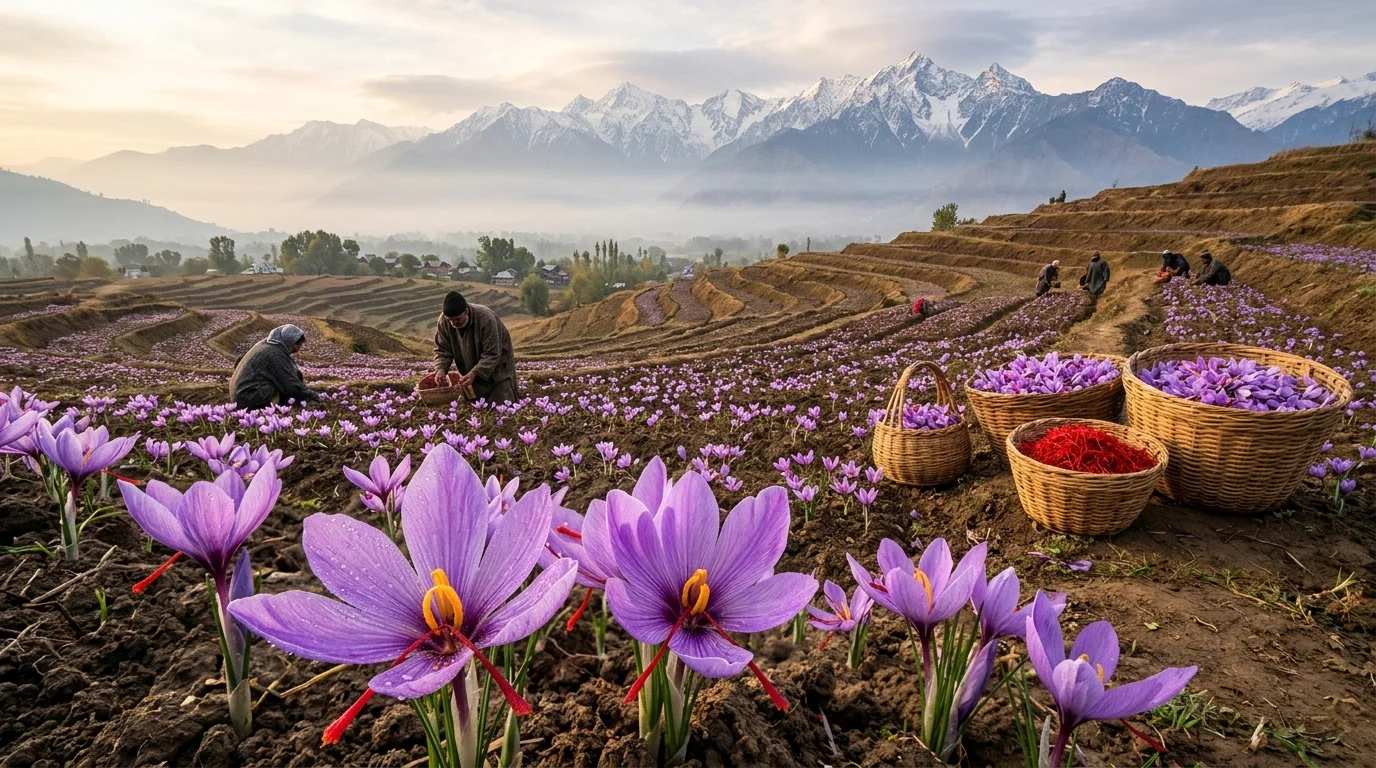
Kashmiri Saffron (locally known as Kong or Kesar) is the most valuable and chemically potent agricultural commodity on earth—revered for centuries for its deep crimson color, potent medicinal safranal aroma, and high crocin percentage (exceeding 8.72%, far outranking Spanish or Iranian saffron). Grown exclusively on the elevated ancient lacustrine plateaus (karewas) of Pampore in Pulwama district, genuine Kashmiri saffron requires over 150,000 purple autumn crocus flowers (Crocus sativus) hand-plucked at dawn to produce just one single kilogram of dried crimson stigmas. However, because of its extreme value (often termed "Red Gold"), the highway stretch between Srinagar and Awantipora is plagued by hundreds of roadside tourist shops selling adulterated Iranian low-grade threads, corn silk dyed with synthetic tartrazine, or shredded coconut fiber soaked in sugar syrup. This guide explains how to identify pure GI-certified Kashmiri saffron, fair farmgate prices, and testing protocols.
1. Quick Reference: Kashmir Saffron Grades & 2026 Prices
| Saffron Grade | Composition & Anatomical Structure | Potency / Crocin Level | Fair Ground Price (per Gram, 2026) |
|---|---|---|---|
| Mongra Grade (Purest) | Only the top deep-red/maroon funnel-shaped stigmas; zero yellow style or base thread | Highest (> 8.5% Crocin) · Darkest crimson brew | ₹300 – ₹420 / gram (Sold in 1g, 5g, 10g sealed glass vials) |
| Lacha Saffron (Traditional) | Whole stigmas attached to their natural yellow/golden base style (roughly 75% red, 25% yellow) | High aroma, slightly lower coloring power due to yellow tail | ₹240 – ₹320 / gram |
| Zarda (Yellow Style Tails) | The bottom yellow thread detached from Mongra harvesting; used in traditional Ayurvedic oils | Moderate aroma, pale yellow coloring | ₹90 – ₹140 / gram |
| Adulterated / Fake Saffron | Dyed corn silk, beetroot-dyed horsehair, or low-potency discarded Iranian powder | Nil / Synthetic chemical color bleeding | ₹100 – ₹150 / gram (Common tourist scam) |
2. The 3 Instant Tests: How to Test Saffron in Front of the Merchant
Never buy saffron in bulk without conducting these three simple physical tests right on the shop counter:
1. The Cold Water Float & Diffusion Test (The Golden Rule)
Ask the shopkeeper for a transparent glass of cold water and drop 3 to 4 individual threads onto the surface:
- Genuine Kashmiri Mongra: Floats on the surface or sinks very slowly. It releases color slowly, producing distinct, wispy golden-yellow halos that expand downward over 10 to 15 minutes. The water turns a vibrant golden yellow—never red. When you pull the thread out after 20 minutes, the physical stigma remains intact and retains its natural deep crimson color.
- Fake / Dyed Saffron: The moment it hits the water, artificial chemical dye instantly bleeds into the liquid within 3 seconds, turning the water dark red or magenta. The thread itself completely bleaches white or pale gray as the dye dissolves.
2. The Baking Soda & Vinegar Reaction Test
If you take a pinch of water infused with real saffron and mix it with a tiny speck of baking soda, pure saffron turns a clean, clear yellow. Adulterated saffron tinted with artificial dyes turns muddy reddish-orange or cloudy brown.
3. The Rub Test (Finger Friction & Aroma)
Rub two dry threads between your clean thumb and forefinger. Genuine saffron feels dry, brittle, and slightly fibrous, emitting an intoxicating scent of fresh hay and sweet honey, but tasting distinctly bitter when touched to the tongue. Fake saffron feels greasy or sticky (from glucose or oil used to artificially add weight) and smells of synthetic chemicals or flat spices.
3. The Pampore Saffron Belt: Visiting the Karewas
Pampore is situated along the main Jammu–Srinagar highway (NH-44), making it an easy 30-minute stop when driving between Srinagar and Pahalgam. If you travel between October 20th and November 15th, the vast fields on both sides of the highway burst into an ocean of delicate purple blossoms. Local farmers harvest the flowers before sunrise when the petals are closed to prevent sun degradation.
Where to Buy with 100% Lab Guarantee: Visit the government-operated India International Kashmir Saffron Trading Centre (IIKSTC) in Dussoo, Pampore. This state-of-the-art facility conducts laboratory quality grading, moisture testing, and infrared spectrometry analysis. Every pack sold here carries official GI certification with QR verification tracking the exact farm plot in Pulwama.

Culinary researcher documenting authentic Kashmiri gastronomic heritage—from the ceremonial 36-course Wazwan to traditional winter Harissa and historic Old City bakeries.
🛡️ Ground-Verified Fact Checking • Srinagar Travel Desk
Plan Your Kashmir Journey with Local Confidence.
Have questions about official taxi union rates, Gondola booking windows, or current seasonal weather? Tell us your dates. Our Srinagar desk verifies your plan and gives you honest local advice in 4 hours.