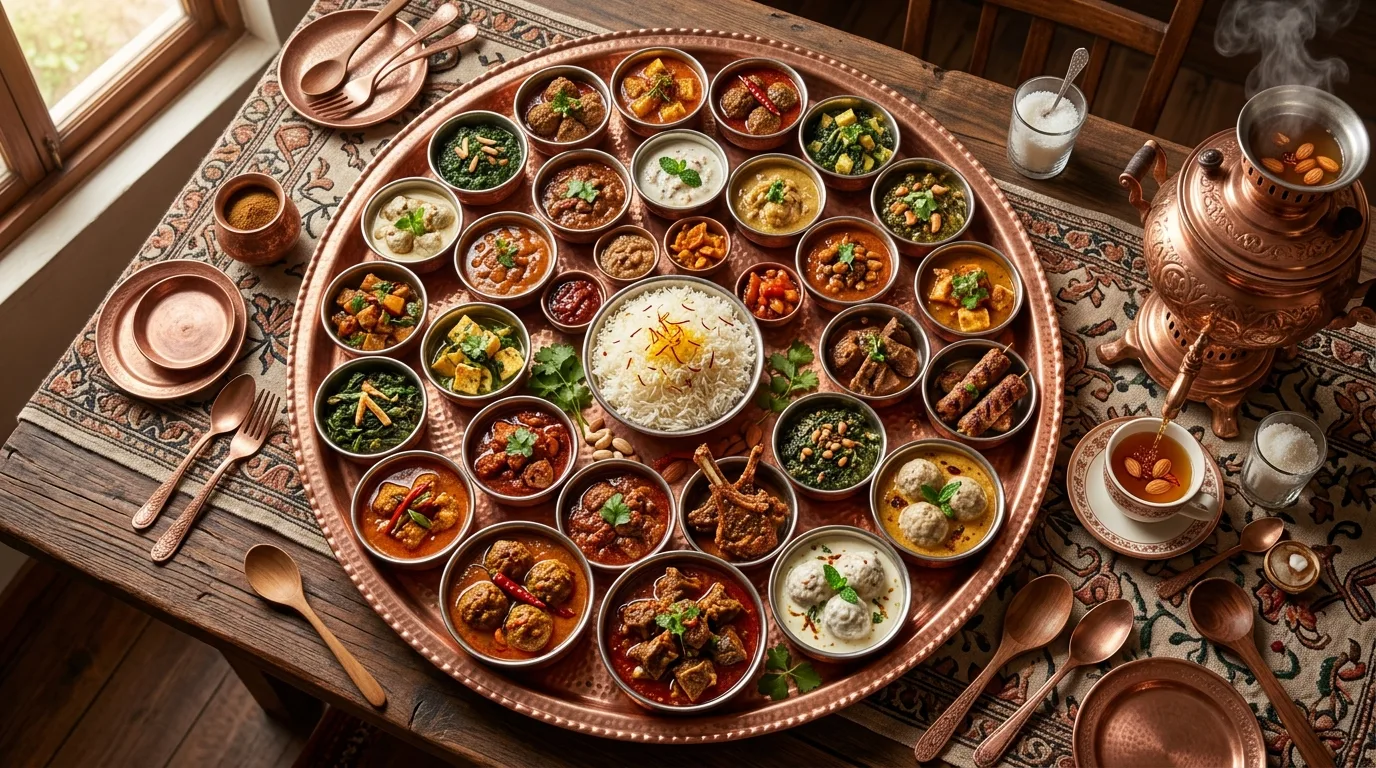
Kashmiri cuisine is one of the world's most sophisticated culinary traditions, born from centuries of Persian, Central Asian, and indigenous Himalayan cultural synthesis along the Silk Road. Grounded in aromatic spices—pure saffron (Kong) from Pampore, dried ginger (Shont), fennel powder (Saunf), black and green cardamom, Kashmiri red chilis (Deggi Mirch), and cockscomb flower extract (Mawal)—the food of the valley divides into two revered master branches: the opulent 36-course royal Muslim banquet known as the Wazwan, and the ancient, fragrant vegetarian and mutton traditions of the Kashmiri Pandits. From morning wood-fired neighborhood bakeries (Kandurs) baking crusty Girda breads, to steaming 12-hour slow-cooked winter Harissa in the medieval alleys of Downtown Srinagar, eating in Kashmir is an unforgettable sensory ritual.
1. Quick Reference: Kashmir's Culinary Hall of Fame
| Culinary Genre | Signature Dish | Primary Flavor Profile | Where to Experience It |
|---|---|---|---|
| The Royal Wazwan | Rista, Tabak Maaz, Rogan Josh, Gushtaba | Saffron, fennel, clarified ghee, curd gravy, mawal flower extract. | Ahdoos & Mughal Darbar (Residency Road, Srinagar) |
| Winter Dawn Breakfast | Harissa with hot Girda bread | Slow-pounded mutton, rice, wild spices, sizzling mustard oil. | Aali Kadal & Saraf Kadal (Downtown Srinagar, 6 AM to 8:30 AM) |
| Neighborhood Bakery | Girda, Lavas, Sheermal, Czochworu | Tandoor-baked breads, sesame, ghee, poppy seeds. | Local Kandur bakeries in every residential lane |
| Street Food & Evening Grills | Charcoal Tujji & Seekh Kebabs | Tender mutton cubes marinated in Kashmiri chili, served with 5 chutneys. | Khayam Chowk & Makai Park (Boulevard Road) |
| Traditional Teas | Kashmiri Kehwa & Pink Noon Chai | Saffron, green cardamom, cinnamon, almonds vs Salted pink brew. | Chai Jaai (Polo View) & street tea stalls |
| Kashmiri Pandit Cuisine | Dum Aloo, Nadru Yakhni, Chaman Kaliya | Asafoetida (Hing), dry ginger, curd, zero onion/garlic. | Grand 7 Restaurant & specialized Pandit homestays |
2. The Sacred 36-Course Royal Wazwan Feast
Wazwan is considered the apex of culinary hospitality in Kashmir. Prepared exclusively by master hereditary chefs known as Vasta Wazas, cooking a grand Wazwan requires days of labor. The mutton is sourced fresh at dawn and hand-pounded for hours on heavy tree logs using massive wooden mallets until the meat transforms into a silken, emulsion-like paste with zero sinew.
The 8 Invariable Master Dishes of Wazwan
- 1. Tabak Maaz: The undisputed king of appetizers. Lamb ribs are first boiled with aniseed, cloves, and milk until completely tender, then shallow-fried in clarified desi ghee until the exterior becomes shatteringly crisp while the interior fat dissolves on the tongue.
- 2. Rista: Tender, velvety hand-pounded mutton meatballs simmered in a fiery, deep crimson saffron broth colored naturally with dried Kashmiri red chilis and ground cardamom. The texture of the meatball is uniquely springy and airy.
- 3. Rogan Josh: A world-famous braised lamb curry prepared with whole spices, garlic paste, and Mawal (the dried petals of the cockscomb flower, Celosia cristata), which imparts its signature brilliant ruby-red hue without excessive heat.
- 4. Daniwal Korma: Succulent pieces of lamb cooked in a rich, fragrant yogurt and fried onion gravy generously garnished with fresh mountain coriander (Daniwal).
- 5. Aab Gosht: Delicate lamb chops simmered in a gentle, creamy milk broth scented with green cardamom and dry ginger, providing a soothing contrast to the spicier dishes.
- 6. Marchwangan Korma: An intensely spicy lamb dish braised in concentrated Kashmiri red pepper paste, wild black cumin, and mustard oil.
- 7. Methi Maaz: Finely minced lamb intestines and offal braised for hours with dried fenugreek leaves (Methi) until deeply aromatic and dark green.
- 8. Gushtaba (The Grand Finale): The undisputed climax of the feast. A colossal, perfectly smooth pounded mutton meatball simmered for hours in a velvety, tangy yogurt and dried mint gravy (Yakhni). Serving Gushtaba signals to guests that the feast has reached its royal conclusion; no further dishes may be served afterward.
The Traem Dining Protocol & Etiquette
Wazwan is not eaten from individual ceramic plates. Four guests sit cross-legged on hand-woven woolen carpets (Qaleen) around a single large, hand-engraved tinned copper platter called a Traem. Before eating:
- Attendants carry a portable, intricately engraved copper basin and water pitcher called a Tash-t-Nari, allowing each guest to wash their hands at the table with warm scented water.
- The Traem arrives covered with a polished conical lid called a Sarposh. When the Sarposh is lifted, a mountain of fragrant basmati rice is revealed, artfully topped with four pieces of Seekh Kebab, four crispy Tabak Maaz ribs, one whole Zafran Kokur (saffron chicken), and portions of Methi Maaz.
- As the meal progresses, the Vasta Waza walks between tables, serving successive courses—Rista, Rogan Josh, Aab Gosht, and Daniwal Korma—ladled directly onto the shared rice.
- Wazwan must be eaten exclusively with the right hand. Sharing food from a single Traem fosters deep social brotherhood and egalitarian unity.
3. Winter Harissa: The 6:00 AM Dawn Breakfast of Old Srinagar
If Wazwan is the celebratory food of summer weddings, Harissa is the soul of Kashmiri winter survival. Prepared exclusively between November and late March during the freezing sub-zero season of Chillai Kalan, Harissa is a centuries-old culinary marvel introduced by Central Asian traders along the Mughal silk routes.
The 12-Hour Overnight Cooking Craft
In the historic quarters of Downtown Srinagar (Shehr-e-Khaas), master artisans known as Harisa-Gaars begin cooking at 5:00 PM the previous evening. Boneless mutton, short-grain rice, garlic paste, green and black cardamom, cloves, and cinnamon are placed into massive earthenware clay cauldrons built into the floor over slow-burning wood-fired tandoors.
Throughout the night for 12 continuous hours, the mixture is vigorously hand-pounded and whipped using heavy long-handled wooden paddles called Choncha. By dawn, every single meat fiber has dissolved into a smooth, velvety, savory porridge.
The Dawn Ritual at Aali Kadal
At 6:00 AM on freezing winter mornings (-5°C), long queues of locals wearing woollen Pherans form outside famous shops like Haji Mohammad Shaban Harissa near Aali Kadal. The artisan ladles the steaming Harissa into clay bowls, garnishes it with crispy fried seekh kebabs, and pours a ladle of smoking hot, sputtering mustard oil over the top. It is eaten immediately using freshly baked crusty Girda bread fresh from the neighboring Kandur bakery. A single bowl of Harissa provides sustained thermal warmth and energy throughout the harshest winter day.
4. The Neighborhood Kandur Bakery: Daily Bread Rituals
Unlike other regions of India where flatbreads (Rotis) are rolled daily at home, Kashmiris rely entirely on traditional neighborhood bakeries operated by master bakers called Kandurs. Every residential lane features a wood-fired sunken tandoor oven producing specialized breads for every hour of the day:
- Tsot / Girda (Breakfast Bread): A medium-sized, round flatbread with characteristic fingertip indentations on its upper crust. Baked on the inner clay wall of the tandoor until golden brown, it is eaten hot for breakfast slathered with salted butter.
- Lavas (Mid-Morning & Snack Bread): An unleavened, wafer-thin, soft round bread. Eaten wrapped around roasted seekh kebabs or paired with mid-morning tea.
- Czochworu (Afternoon Tea Roll): A golden, crusty ring-shaped roll sprinkled with poppy seeds (Khashkhash) or white sesame. Its crisp crust and soft, chewy crumb make it the perfect dipping companion for hot pink Noon Chai.
- Sheermal (Sweet Saffron Bread): A mildly sweet, dense, crumbly biscuit-bread infused with saffron milk, ghee, and cardamom, often enjoyed during festivals.
- Bakarkhani (Celebration Bread): A rich, multi-layered flaky puff pastry bread rolled with ghee and baked slowly. Popularly served during weddings and engagements.
5. Kashmiri Tea Culture: Kehwa vs. Noon Chai
Tea in Kashmir is not merely a beverage; it is a hospitality cornerstone simmered in ornate charcoal-heated copper Samovars:
Kashmiri Kehwa (The Royal Golden Elixir)
Kehwa is a celebratory, pale golden infusion of green tea leaves simmered with whole crushed green cardamom, cinnamon barks, and strands of pure Kashmiri saffron. Poured into delicate glass cups, it is garnished with a generous spoonful of finely slivered raw almonds and sweetened with wild mountain honey or sugar. It is celebrated for its digestive and immunity-boosting qualities.
Noon Chai / Sheer Chai (The Iconic Pink Salt Tea)
Noon Chai (meaning Salt Tea) is Kashmir’s everyday comfort brew, consumed two to three times daily. Prepared through an intricate scientific brewing process: green tea leaves are boiled with water, sodium bicarbonate (baking soda), and fresh water, then continuously aerated with a ladle until chemical oxidation creates its distinctive deep rosy pink hue. Milk, sea salt, and crushed walnuts are added to create a soothing, savory, and creamy hot tea.
6. Street Food & Evening Grills at Khayam Chowk
As twilight settles over Srinagar, the intersection of Khayam Chowk transforms into a bustling, smoke-filled culinary spectacle. Charcoal grills glow cherry-red as master kebabiers prepare Tujji:
- Tujji (Charcoal Mutton Skewers): Bite-sized cubes of tender mutton marinated in garlic, dried ginger, and Kashmiri chili, skewered onto thin iron rods and grilled over glowing charcoal coals.
- The 5 Chutneys: Served piping hot on fresh soft Lavas bread accompanied by a circular platter of five signature chutneys: spicy fiery red chili, mint-yogurt, sweet onion-vinegar relish, grated radish-walnut (Doon Chetin), and cucumber curd. A full skewer platter costs ₹250 to ₹350.
7. Traditional Kashmiri Pandit Vegetarian Cuisine
While Kashmiri Muslim cuisine relies heavily on garlic, shallots (Praan), and tomatoes, traditional Kashmiri Pandit cuisine is completely satvik—prepared without onions or garlic, relying instead on Hing (asafoetida), dry ginger powder (Shont), and fennel seed powder (Saunf):
- Kashmiri Dum Aloo: Baby potatoes parboiled, pricked hundreds of times with toothpicks, deep-fried in cold-pressed mustard oil until crisp, and slow-simmered in a thick, fragrant yogurt-and-fennel red gravy.
- Nadru Yakhni: Crisp, fresh lotus stem discs harvested from Dal Lake, simmered in a velvety, white yogurt gravy infused with dry mint and cloves.
- Chaman Kaliya (Turmeric Cottage Cheese): Fresh golden-fried paneer cubes braised in a bright yellow turmeric and milk gravy flavored with fennel.
- Haakh: The undisputed staple green of Kashmir. Fresh collard greens quickly sautéed in mustard oil with a pinch of asafoetida, whole green chilies, and salt, retaining their vibrant emerald crunch.
8. Top Recommended Restaurants & Food Hubs in Srinagar
- Ahdoos Restaurant (Residency Road): Established in 1918 on the banks of the Jhelum, Ahdoos is the undisputed benchmark for authentic Wazwan. Order the classic Traem or individual portions of Tabak Maaz, Rista, and Gushtaba.
- Mughal Darbar (Residency Road): Legendary, bustling multi-level dining hall famous for generous, high-quality Wazwan plates and traditional family dining.
- Chai Jaai Tea Room (Polo View): A charming British-Cotswold-meets-Kashmir tea salon serving authentic Kehwa, Noon Chai, and fresh bakery pastries served in traditional silver Samovars.
- Krishna Vaishno Dhaba (Dalgate): The premier destination for clean, authentic pure-vegetarian Punjabi and Kashmiri dishes (renowned for Rajma Chawal, Kheer, and Dum Aloo) at economical prices (₹180 – ₹250 per meal).
- Aali Kadal Harissa Quarter (Downtown Srinagar): Historic dawn breakfast cluster (Nov–Mar only) where multi-generational artisans serve steaming Harissa right out of floor tandoors.
9. Frequently Asked Questions (PAA Analysis)
Can solo travelers or couples order Wazwan without ordering a 4-person Traem?
Yes! Standard restaurants on Residency Road (Ahdoos, Mughal Darbar, and Kareema) offer "Mini Wazwan Platters" or individual bowls of Rista, Rogan Josh, and Gushtaba, allowing solo diners and couples to sample signature dishes without paying for an entire 4-person banquet.
Is Kashmiri food excessively spicy?
No. While Kashmiri dishes look intensely red, that color comes from Kashmiri red chilis (Deggi Mirch) and Mawal flowers, which provide vibrant color and mild warmth rather than burning chili heat. The flavor profile is aromatic, soothing, and dominated by fennel, ginger, and cardamom.
Is pure vegetarian food easily available in Kashmir?
Yes! Contrary to popular misconception, vegetarian food is widely available across Srinagar, Gulmarg, and Pahalgam. Pure-veg restaurants like Krishna Dhaba in Dalgate and Punjabi dhabas in market centers cater extensively to vegetarian travelers.

Culinary researcher documenting authentic Kashmiri gastronomic heritage—from the ceremonial 36-course Wazwan to traditional winter Harissa and historic Old City bakeries.
🛡️ Ground-Verified Fact Checking • Srinagar Travel Desk
Plan Your Kashmir Journey with Local Confidence.
Have questions about official taxi union rates, Gondola booking windows, or current seasonal weather? Tell us your dates. Our Srinagar desk verifies your plan and gives you honest local advice in 4 hours.